The short answer
- Two days, about three hours of work. Bake on the first day and leave the pieces to go cold and hard; build and decorate on the second.
- Firm dough, rolled 5 mm thick. Cut round a card template, then trim the pieces again while they are warm, so the edges meet.
- Icing as thick as toothpaste. Royal icing that holds a stiff peak glues the walls. Prop them with tins and give them a few hours before the roof goes on.
- Or buy a kit of ready-baked walls: about £6 with the icing and sweets in the box. The building and the waiting are the same.
What you need
For the gingerbread (one house about 15 cm tall)
- 175 g butter
- 150 g dark muscovado sugar
- 5 tbsp golden syrup (about 100 g)
- 425 g plain flour
- 1½ tsp bicarbonate of soda
- 1 tbsp ground ginger
- 1 tsp ground cinnamon
These are the proportions of BBC Good Food’s and Lakeland’s tested recipes (melted butter, sugar and syrup, and no egg), scaled down for the template below, with a little cinnamon added. The dough left over makes a few gingerbread people.
For the icing glue
- 2 egg whites (on raw egg, see “Making one with children”)
- 500 g icing sugar
- 1 tsp lemon juice
- Or, instead of all three, a bag of royal icing mix: Squires Kitchen Professional Royal Icing, 500 g Ocado, £5; add 75 ml of cooled boiled water
For building and decorating
- Thin card for the template (a cereal box), a ruler, a pencil and scissors
- A rolling pin, baking paper and two baking trays
- A small sharp knife or a pizza wheel
- A piping bag, or a freezer bag with a corner snipped off: Dunelm 50 Disposable Icing Bags Dunelm, £3.50
- A board about 30 cm across to build on: White Round Cake Drum 12 Inches Hobbycraft, £3.50
- Four to six tins or jars to prop the walls
- Sweets for the roof and the garden, and icing sugar for snow
The template
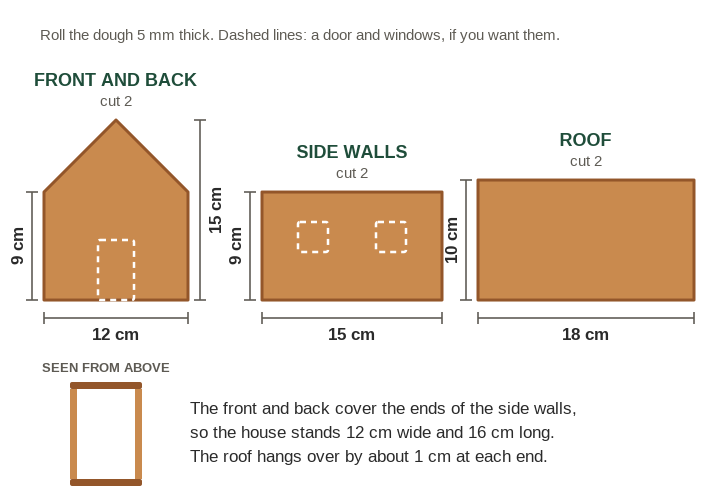
Draw the pieces on thin card and cut them out. For the front and back, draw a rectangle 12 cm wide and 9 cm tall, mark a point 15 cm up the middle line, and join it to the two top corners.
| Piece | Cut | Size | Note |
|---|---|---|---|
| Front and back | 2 | 12 cm wide, 9 cm at the sides, 15 cm at the point | a door 3 cm by 5 cm in the front, if you like |
| Side walls | 2 | 15 cm by 9 cm | two windows 2.5 cm square, if you like |
| Roof | 2 | 18 cm by 10 cm | the long edge runs along the house |
For a bigger house, Jamie Oliver’s free printable template (five A4 pages, with its own recipe) has side walls 20 cm by 14 cm.
How to make a gingerbread house, step by step
Day 1: bake the pieces (about 2 hours)
- Make the dough 15 minutes Melt the butter, sugar and syrup in a pan over a low heat, stirring. Mix the flour, bicarbonate of soda and spices in a big bowl, pour in the melted mixture and stir, then knead it into a smooth, stiff dough. If it will not come together, add a tiny splash of water.
- Cut out the template 10 minutes While the dough cools a little, draw the six pieces on card and cut them out.
- Roll it out on baking paper 15 minutes Roll a third of the dough at a time on a sheet of baking paper, 5 mm thick and the same all over: thin patches burn and thick ones stay soft. Rolling on the paper means the pieces never have to be lifted. If the dough is very sticky, wrap it and chill it for 30 minutes first.
- Cut the pieces 10 minutes Lay the card on the dough, cut round it with a sharp knife and peel the scraps away, leaving about 1 cm between pieces. Cut the door and windows now. Slide the paper onto a baking tray.
- Bake 10 to 12 minutes a tray At 200°C (180°C fan, gas 6), until firm and a little darker at the edges.
- Trim the pieces while they are warm 5 minutes Leave them a few minutes to firm up, then lay the card back on and trim round it again. Gingerbread spreads a little in the oven, and straight edges are what make the walls meet.
- Leave them flat until cold overnight Cool them on the tray, then leave them flat. Cold, hard pieces are much easier to build with than warm ones.
Day 2: build it and decorate it (about an hour and a half, and a few hours’ wait)
- Make the icing glue 10 minutes Put the egg whites in a big bowl, sift in the icing sugar, add the lemon juice and whisk until the icing is thick and glossy and holds a stiff peak: about as thick as toothpaste. Keep it covered with a damp cloth, because it dries fast.
- Decorate the walls while they are flat 20 minutes Window frames, a door, bricks and sweets are far easier to pipe and stick on a flat piece. Give them 15 minutes before the walls stand up.
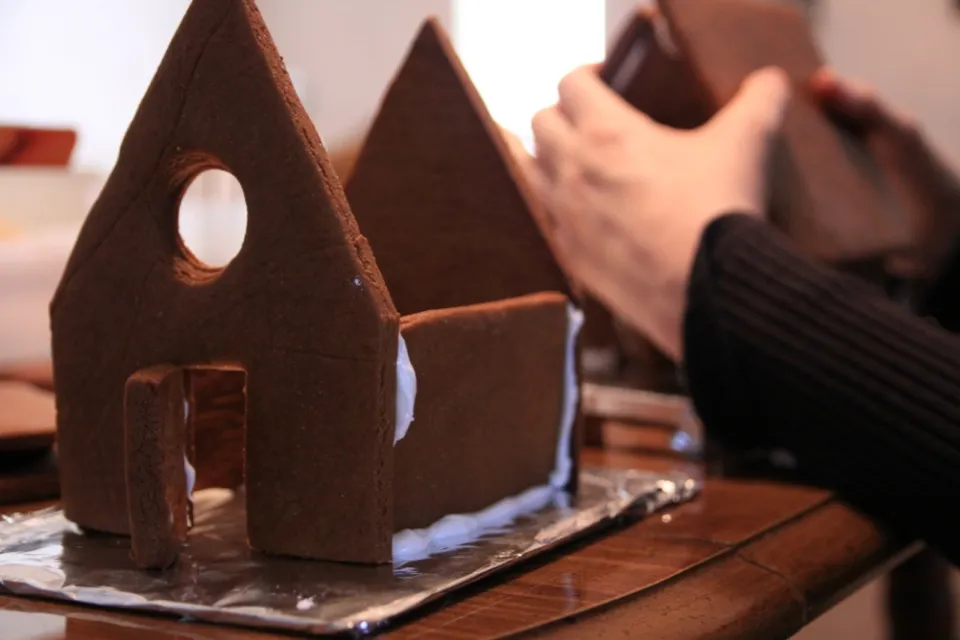
- Stand up the walls 10 minutes Pipe a thick line of icing along the bottom and side edges of the front. Stand it on the board, press a side wall against it at a right angle, inside its edge (see the drawing above), and hold them for a minute or two. Prop both with tins. Add the back, then the other side.
- Leave the walls to set a few hours Leave them propped until the icing is hard. BBC Good Food says ideally a few hours; Mary Berry leaves hers at least 4 hours, and preferably overnight. A roof on soft walls pushes them apart.
- Put on the roof 15 minutes Take the props away. Pipe icing along the tops of the side walls and the sloping edges of the front and back. Press on one roof panel and hold it firmly for a few minutes until the icing grips, because the slope is steep. Then the other, with icing along the ridge where they meet.
- Decorate it 30 minutes Pipe along the ridge and the eaves, stick sweets on with dots of icing, and dust the roof and board with icing sugar for snow. Leave it to dry completely, ideally overnight.
Why gingerbread houses fall down, and how to fix it
| What goes wrong | Why | The fix |
|---|---|---|
| The walls slide apart | The icing is too runny, or the joins were not held long enough. | Beat in more icing sugar until it holds a stiff peak. Hold each join for a minute or two and prop it with tins. |
| The roof slides off | It went on before the walls had set, or it carries too many heavy sweets. | Wait a few hours after the walls. Hold each roof panel for a few minutes. Put heavy sweets on the board, not the roof. |
| The corners do not meet | The pieces spread in the oven. | Trim them to the template while they are still warm. |
| The pieces bend | They are under-baked, rolled thin, or still warm. | Bake until firm and darker at the edges, roll to 5 mm, and build only when they are cold. |
| A piece breaks | It was lifted while hot, or knocked. | Glue it with icing, hold it until it sets, and hide the crack under icing snow or a sweet. |
| The icing dries in the bag | Royal icing sets in the air. | Keep the bowl covered with a damp cloth and fill the bag a little at a time. |
Ideas for decorating it
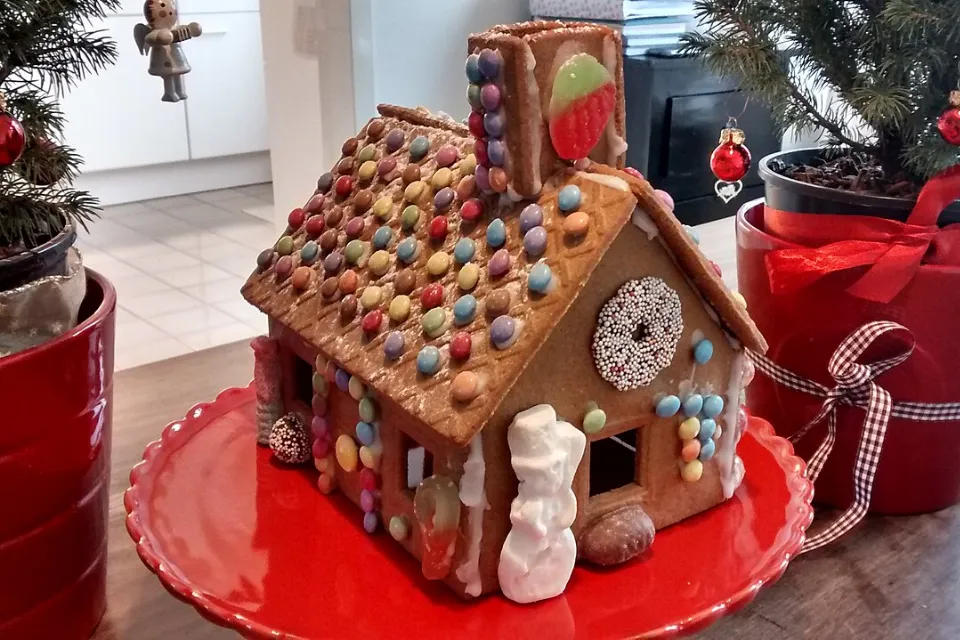
- Roof tiles: chocolate buttons in overlapping rows from the bottom up, or squares of cereal, or wafer biscuits.
- Windows that glow: fill the window holes with crushed boiled sweets after the first bake and give the walls 3 to 4 minutes more, until the sweets melt: Mary Berry’s way. They set clear, and a battery tea light inside makes them glow.
- Snow: icing sugar shaken through a sieve over the finished house and the board, and icicles piped along the eaves: a dot of icing pulled down and away.
- A garden: a path of chocolate drops, a woodpile of pretzel sticks, a fence of candy canes, and trees made from upside-down ice cream cones with green icing.
- A family: gingerbread people cut from the leftover dough, standing at the door.
Gingerbread house kits, if you would rather not bake
A kit gives you baked walls, and most give you the icing and sweets as well. Steps 10 to 13 above still apply: thick icing, props, and time before the roof.
Every price on this page was read on the shop’s own page on 28 November 2026; none of these kits had an offer of its own. The Ocado, Morrisons and Hobbycraft kits could be ordered online; IKEA’s page did not show its stock. Check the allergens on the box: the M&S kit’s sweets contain beef gelatine. Prices and stock change, so check the shop. We are not paid for these links. The shops are in the UK.
| Kit | Shop and price | In the box |
|---|---|---|
| VINTERSAGA gingerbread house, 300 g | IKEA, £3.75 | the walls and roof only: no icing and no sweets (the page gives an icing recipe) |
| Morrisons Decorate Your Own Gingerbread Christmas House Kit, 668 g | Morrisons, £6 | walls and roof, a white and a red icing tube, a gingerbread man and sugar decorations |
| Create A Treat Gingerbread House Mini Village, 299 g | Ocado, £6 | pre-baked pieces, a pouch of icing and sweets, packed on a building tray |
| M&S Build Your Own Gingerbread House | Ocado, £7 | six panels, a white icing tube with nozzles, a red one, jelly sweets and sugar decorations, and a plastic base |
| Create A Treat Mini Gingerbread House, 411 g | Ocado, £7 | pre-baked panels, icing, sweets, a piping bag and a base marked where the walls go |
| PME Christmas Ready-to-Build Gingerbread House Kit, 600 g | Hobbycraft, £15 | pre-baked gingerbread, a royal icing mix, sprinkles, two piping bags and a building tray |
Making one with children
- Give each child a wall. Decorating a flat piece on the table is the part children enjoy most; a grown-up does the building.
- Raw egg in the icing. The Food Standards Agency says young children, people who are pregnant and older people can now safely eat raw or lightly cooked hen eggs with the British Lion mark or from the Laid in Britain scheme. Its advice does not apply to people who are severely immunocompromised.
- Melted sugar glue is for grown-ups. Some recipes glue the walls with caramel, which sets in seconds; Arla warns that the liquid caramel is hot and should not be handled by children.
- Small sweets and the youngest. Kits such as Create A Treat’s warn that small sweets may be a choking hazard for children under 3: choose bigger sweets, or keep the finished house out of reach.
- Two short sessions. Bake on one day and build on the next, so nobody sits waiting for icing to set.
Questions about making a gingerbread house
How do you make a gingerbread house stay together?
Use royal icing thick enough to hold a stiff peak, trim the pieces to the template while they are warm so the edges meet, and hold each join for a minute or two with tins to prop it. Leave the walls a few hours before the roof goes on.
How long does it take to make a gingerbread house?
About three hours of work over two days: about two hours to make, bake and trim the pieces on the first day, and about an hour and a half to build and decorate on the second, with a few hours between the walls and the roof.
How long should the walls set before the roof goes on?
A few hours. BBC Good Food says ideally a few hours, and Mary Berry leaves hers at least 4 hours and preferably overnight. Kits with ready-made icing ask for less: hold each join for about a minute.
What do you use to stick a gingerbread house together?
Royal icing: egg white and icing sugar whisked until it holds a stiff peak, or a royal icing mix made up with water. Melted sugar sets faster but is very hot, so it is for grown-ups only.
How long does a gingerbread house last?
BBC Good Food says about a week to eat, though it lasts much longer as a decoration; Jamie Oliver says about 5 days. Lakeland suggests making it 5 to 7 days before Christmas and says it stays edible for about 2 weeks.
What size should a gingerbread house template be?
The template on this page makes a house 12 cm wide, 16 cm long and about 15 cm tall: a front and back 12 cm wide and 15 cm to the point, side walls 15 by 9 cm, and two roof pieces 18 by 10 cm, rolled 5 mm thick.